
When athletes hear that sudden crack after a hard tackle, awkward fall, or collision during play, their mind often goes straight to the worst-case scenario: a bone fracture, time away from training, surgery, and a long recovery period. Of course, there’s also the pain, the cast, the brace, and all the challenges that come with them.
Indeed, bone fractures are among the most serious injuries in sports. But with immediate immobilization and proper medical care, athletes return to training and competition every day.
There are five stages of fracture healing, from the initial hematoma and soft callus formation to bone remodeling and a return to activity. How long recovery takes depends on which bone broke and how severe the fracture is.
After all, recovering from a fractured pinky after a basketball game is very different from recovering from a broken leg after a hard fall.
So let’s take a look at the five stages of fracture healing, what athletes can expect during each one, and the expert advice that helps recovery stay on track.
What Happens When a Bone Breaks?
When a bone breaks, that’s called a fracture. In sports, fractures usually happen after a significant force is applied to the body, such as a hard tackle, a fall, a collision, or an awkward landing.
So, to put it in simple terms, a fracture means a bone cracks or breaks because more force is applied to it than it can withstand.
In medical terms, a fracture is a disruption in the continuity of the bone. Along with immediate pain, athletes often notice swelling, bruising, loss of function, and difficulty putting weight or stress on the injured area. In some cases, the affected limb may even appear out of alignment.
The most common fractures in sports affect the fingers, wrists, hands, arms, feet, and legs. Recovery can vary widely depending on the bone involved, the severity of the injury, and whether surgery is required. A simple fracture may heal in a matter of weeks, while more complex injuries can take months before an athlete is ready to return to full activity.
Fractures can happen in many sports, especially those involving high-speed movement, contact, or repetitive impact. Common causes include:
- Tackles and collisions
- Falls
- Twisting or awkward movements
- Heavy impact or pressure
Types of Bone Fractures
There are typically eight bone fracture classifications, depending on how the bone breaks. For simplicity, here we’ll focus on four main categories:
Displacement of the Bone Break
In a non-displaced fracture, the bone remains aligned even though a break has occurred. In a displaced fracture, the broken ends shift out of position and no longer match their original alignment.
Completeness of the Break
A complete fracture means the bone breaks all the way through, separating into distinct pieces. An incomplete fracture means the bone cracks but does not fully separate, as commonly seen in children’s greenstick fractures.
Orientation of the Break
Fractures can also be classified by the direction of the break. If the fracture line runs across the bone, it is called a transverse fracture. If it runs along the length of the bone, it is called a longitudinal or linear fracture. Other patterns include oblique and spiral fractures.
Penetration of the Skin
Another important distinction is whether the fracture breaks through the skin. A closed fracture remains beneath the skin, while an open fracture pierces the skin and creates an external wound.
First Aid For Bone Fractures
The moment a fracture happens, the body’s healing process begins. But before we get into the 5 stages of fracture healing, let’s cover what to do if you suspect a broken bone:
- Immobilize the injured area immediately: Moving a fractured bone can worsen the injury and make recovery more difficult. Try to keep the area as still as possible.
- Stop playing or training right away: Whether it’s during a game, practice, or workout, don’t try to push through it. Continuing to load the injured area can lead to additional damage.
- Seek medical attention as soon as possible: Fractures require proper evaluation, usually with X-rays or other imaging studies, to determine the type of fracture and the appropriate treatment.
- Avoid putting weight or stress on the injured area: Until a healthcare professional assesses the injury, assume the bone needs protection and support.
The 5 Stages of Fracture Healing
The fracture healing process follows a predictable sequence, but the stages often overlap. The exact bone healing timeline depends on the bone involved, the severity of the injury, and the athlete’s overall health.
Still, the 5 stages of fracture healing generally follow the same pattern: hematoma formation, soft callus formation, hard callus formation, bone remodeling, and consolidation with a return to activity.
Stage 1: Hematoma Formation (0–7 days)
The first stage of fracture healing begins immediately after the bone breaks. Blood vessels inside and around the bone rupture, causing internal bleeding at the injury site.
That blood quickly forms a clot called a hematoma. Its job is to contain the bleeding and create a temporary framework where healing can begin. At the same time, inflammation increases around the fracture. While swelling and discomfort are never pleasant, they are a necessary inflammatory response. This reaction helps bring nutrients, immune cells, and chemical signals to the injured area.
This is also when stem cells begin migrating to the fracture site. Along with growth factors, they help create the granulation tissue that will eventually support new bone formation.
One of the most important goals during this stage is immobilization, as it sets the foundation for the next stages of bone repair.
Stage 2: Soft Callus Formation (1–3 weeks)
Within the first few weeks of a bone fracture, the body begins building a soft callus around the fracture site. This is one of the most important stages of fracture healing because the broken ends of the bone start reconnecting.
The soft callus acts as a temporary bridge between the fractured bone segments. It is largely made of cartilage and collagen-rich tissue, providing flexibility while the area continues to stabilize. At this stage, the repair is still relatively fragile, which is why casts, braces, and other forms of immobilization remain important.
The amount of callus produced often depends on how stable the fracture is. The more stable and supported the bone remains, the less callus the body typically needs to create. A smaller, well-organized callus often leads to a more efficient healing process.
When excessive movement occurs at the fracture site, the body responds by building a larger callus to compensate for the instability. So even during stage 2 of fracture healing, it’s important to keep the area immobilized.
Stage 3: Hard Callus Formation (4–6 weeks)
As bone healing progresses, the soft callus begins to harden. During this stage, the cartilage-rich tissue is gradually replaced by immature woven bone through a process called ossification.
This new hard callus creates a stronger connection between the fractured bone ends. This means the injury is becoming more stable, but the bone has not yet returned to its original strength. While pain is often reduced compared to the earlier stages, the fracture still requires protection and careful progression.
Depending on the injury and medical guidance, athletes may begin light rehabilitation during this stage. The focus is usually on maintaining mobility, restoring joint movement, and preventing excessive muscle loss around the injured area.
For many patients, this is also when treatment begins transitioning from a cast to a brace or other form of support.
Stage 4: Bone Remodeling (6 weeks–months)
At this stage, the body now begins refining the repair. The immature woven bone formed during the earlier stages is gradually replaced by stronger lamellar bone.
As this process continues, the callus becomes smaller and the bone starts resembling its original shape. Inside the bone, blood supply continues to improve and the internal structure becomes more organized.
Most athletes notice significant improvements in pain, stability, and function during this stage. Depending on the fracture and medical clearance, rehabilitation often progresses toward strength training, balance work, endurance exercises, and more demanding movement patterns.
Even though the area feels much stronger, bone remodeling is a slow process that continues several months. The fractured area is influenced by Wolff’s Law, which means that bone remodeling adapts to the loads placed upon it. As activity gradually increases, it becomes stronger and will better handle the stresses of daily life, training, and sport.
Stage 5: Consolidation & Return to Activity (8 months–1 year)
The final stage of fracture healing is consolidation. By this point, the hard callus has been reshaped into mature lamellar bone, circulation has largely been restored, and the fracture site is approaching its original strength.
While bone remodeling continues in the background, the fracture is now considered functionally healed. For many athletes, this is when the focus shifts from recovery to performance.
Returning to activity happens gradually and under medical guidance. Even though a fracture may appear healed on imaging, it doesn’t necessarily mean it’s 100% ready to return to sport.
Physiotherapy & Recovery After Fracture
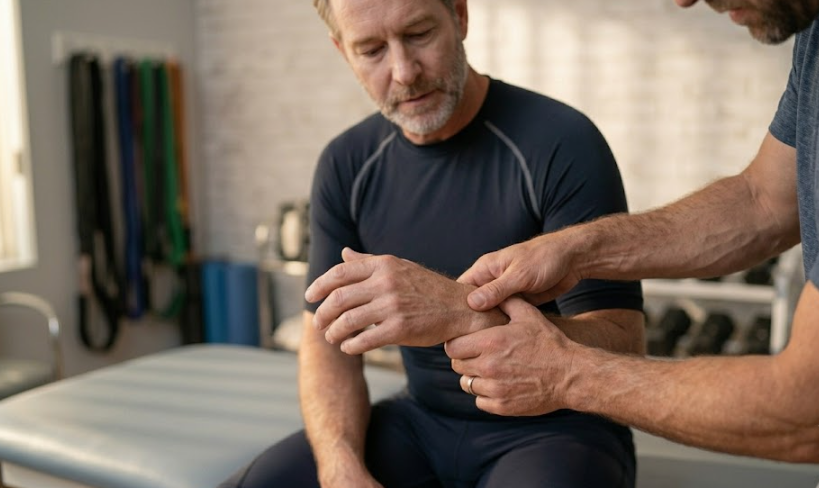
When going through fracture recovery, exercises always start light. In the beginning, the focus is usually on restoring movement, reducing stiffness, and getting the injured area working again. Strength and endurance work come later.
Here at P1, our physical therapy team has helped athletes recover from fractures, sprains, strains, and other injuries for over 20 years. And here’s something we tell everyone, from elite athletes to someone who just had an accident: recovery timelines are personal.
What we covered here is an overview of the fracture healing process. Your real recovery depends on your age, medical history, activity level, the type of fracture, and how well the bone is healing.
So how does our PT team approach each case? We look at patient feedback, movement, pain levels, and medical scans. Because recovery is not about pushing through pain. That can compromise healing and slow down your return.
Each rehab session helps us assess where you stand and what your body is ready for next. As the bone heals, exercises progress from mobility work to strength, balance, endurance, and eventually sport-specific movement.
That said, there are a few additional recommendations we also give athletes to support bone fracture recovery.
Tips to Support Bone Healing
To wrap things up, here are some of the most important things athletes can do to support the fracture healing process:
- Immobilize the injury. Use your cast, brace, or other support for as long as your doctor recommends. Stability is one of the most important factors during the early stages of bone repair.
- Prioritize rest and sleep. Recovery is an active process for your body. Especially during the early stages of fracture healing, focus on giving your body the time and energy it needs to recover.
- Follow a recovery-focused diet. Nutrients like calcium, phosphorus, protein, iron, and key vitamins all help support bone formation and remodeling. If you’d like a detailed breakdown of what to eat during recovery, check out this guide to nutrition for bone healing.
- Manage stress levels. Fracture recovery can be mentally challenging, especially for athletes who are used to training regularly. Check out our guide on coping mechanisms for athletes for practical ways to manage the mental side of injury recovery.
- Avoid smoking and limit alcohol. Both can interfere with the body’s ability to build and remodel bone tissue.
- Use ice appropriately. Ice can help manage pain and swelling, particularly during the early stages after injury. A few short sessions throughout the day are usually more effective than prolonged icing.
How to Heal Bone Fractures Faster
As we said from the beginning, bone healing takes time. The body still needs to move through the 5 stages of fracture healing, and there is no shortcut around that process.
But what you can do is avoid the common mistakes that slow recovery down. Get the right medical care and follow immobilization guidelines. Eat well, sleep well, and progress through rehab at the pace your recovery allows.
Fracture recovery starts with rest and immobilization during the hematoma and soft callus stages. As healing progresses, physical therapy gradually introduces mobility work, followed by strength training, balance exercises, and sport-specific movements. The goal is to support the fracture healing process without placing too much stress on the bone too soon.
If you’ve suffered a bone fracture, we’re here to help. At P1, our team of physical therapists help athletes recover from injuries during all seasons. Every fracture is different, which is why recovery should never be a one-size-fits-all process.
So become a P1 member today, and let’s build a recovery plan that gets you moving, training, and performing at your best again.
