
You’ll see jump training in almost every elite athlete’s program. They help build strength, leg power, and neuromuscular control. All the things athletes need to move fast, react quickly, and stay explosive during big plays.
But jump exercises offer many benefits for anyone who can safely include them, not just athletes. A jumping workout can lift your cardio, strengthen your bones, support your immune system, and even improve your gut health.
Jump training drills just wake your mind and body up.
So let’s go through the 10 best jump training exercises for all levels. We’ll cover everything from beginners who want to stay active and healthy to advanced athletes chasing that extra performance edge.
What is Jump Training?
Jump training is any workout that involves vertical or horizontal jumping. You see it in almost every sport, like football, basketball, soccer, volleyball. Even when running, every stride in a sprint is its own tiny jump.
Any time you jump, you follow the same pattern: You load force with your legs, then you explode. You contract, then you extend. That is the basic biomechanics behind a jump and behind most explosive power exercises.
Good jumping technique is about controlling strength, balance, and direction. It is also about learning how to land well. The legs, ankles, knees, and feet do most of the work, but your core and arms help you stay stable and generate more height or distance.
Typical jump training exercises include squat jumps, skipping, box jumps, and jumping jacks. These look a lot like classic plyometric jump training, and many coaches use both terms in the same way.
But there is a small difference.
All jump exercises fall under the plyometrics category. But not all plyometrics involve jumping.
Let’s explain: Plyometric training covers any explosive sports movement. Of course, this includes jumping, but it can also be a swing, a throw, a punch, or a medicine ball slam. The same load and explode principle, but not always related to jumping.
With that distinction out of the way, let’s look at why jump exercises and plyometrics can be so good for your health.
Benefits of Jump Training Exercises
Jump exercises help athletes build strength, agility, and speed for explosive game movements. They use the floor as their platform to jump higher, shoot, block, and stay quick on every play.
Jump training also teaches athletes how to land safely during fast, intense moments. That matters for injury prevention in basketball, football, and volleyball. It is especially helpful for contact athletes.
But if you are not an athlete, the benefits of jumping exercises can still be very interesting for you. Let’s have a look:
- Improves Heart Health: Jumping is intense and gets your heart working. It helps you build endurance and handle fatigue better.
- Boosts the Immune System: When your blood and lymphatic systems pump faster, your body moves oxygen and nutrients more efficiently. This supports cell renewal and immune function.
- Burns Fat: Jumping is high effort and uses a lot of stored energy. In fact, a jumping workout can burn as many calories as jogging.
- Increases Bone Density: Jump exercises stimulate bone strength and help reduce the risk of osteoporosis. This is a big benefit for anyone past their mid thirties, as from that age bones and joints start to lose strength.
- Improves Posture: Each jump forces your core to stabilize and your arms to balance you. This can prevent home and outdoor injuries in daily life for most people.
- Improves Coordination: Jump training drills activate the connection between your brain and your muscles. You react faster and move with more precision.
Best Jump Training Exercises
Before starting any jump exercise, it is really important to warm up. Your muscles and joints need to be prepared for fast contraction and extension. That’s how you avoid injury, and progress consistently.
So be sure to not literally jump into these workouts, without first warming up.
Here we’ll go through our top ten jump training exercises, from beginner to advanced.
Squat jumps
Level: Beginner
This jump training exercise starts with a squat to load force, then a jump to explode upward. It helps you build leg power and learn how to jump higher.
Squat jumps strengthen your hips, glutes, quads, hamstrings, and calves. It is high intensity, so it raises your heart rate and burns calories fast.
How to do Jump Squats:
- Start with your feet shoulder width apart, chest up, and your body tall.
- Lower into a squat until you reach a comfortable depth above the knee line.
- Explode upward. Swing your arms and push the floor away.
- Land softly with your knees bent. Reset your posture and repeat.
Box step-ups with jump
Level: Beginner
This jump training exercise mixes a box step up with a small jump at the top. It works your hips and upper legs, which makes it great for building glute and hamstring strength. It also challenges balance, so it is a good choice for beginners learning control.
How to do Box step-ups jumps:
- Stand tall in front of the box with your feet shoulder width apart.
- Step one foot onto the box. Drive through that leg to lift your body up.
- At the top, add a small jump by extending both legs.
- Land softly on the box. Step down slowly and switch legs.
Jump rope
Level: Beginner
Jump rope is one of the most complete jump exercises you can do. It trains speed, coordination, and endurance. It burns calories fast and is excellent for cardiovascular health.
You can progress to single leg jumps, double unders, or crosses once you master the rhythm.
How to jump rope:
- Hold one handle in each hand with the rope behind you.
- Swing the rope overhead with your wrists.
- Jump lightly as the rope reaches your feet. Both feet leave the ground at the same time.
- Keep a steady rhythm and stay relaxed.
Box jumps
Level: Intermediate
Box jumps help you increase vertical jump height and build explosive leg power, and they also improve your ability to land softly. Many athletes rely on them as part of their vertical jump workout.
How to do box jumps:
- Stand tall in front of the box.
- Bend your knees and bring your arms back to load power.
- Jump up onto the box and land on both feet.
- Extend your legs to stand up fully.
- Step down from the box slowly.
Lunge jumps
Level: Intermediate
Lunges work every muscle in your lower body. When you add the jump, you train explosive leg power and balance at the same time.
Because this is an asymmetrical movement, your core works hard to stabilize you. Lung jumps are really one of the most complete jump workouts.
How to do lunge jumps:
- Drop into a lunge with your front leg flexed and your back knee close to the ground.
- Push into the floor and jump, switching legs in the air.
- Land softly with the opposite leg forward.
- Reset and repeat.
Broad jumps
Level: Intermediate
Broad jumps measure how far you can jump, so they are great for developing horizontal power and coordination.
Your goal here is to project your body forward with control. It’s important you have a clear starting line, and if you can get a cone or pylon to set a target, then better.
How to do broad jumps:
- Stand tall on your starting line.
- Bend your knees to load power. Lean slightly forward and bring your arms back.
- Explode forward and swing your arms.
- Land with soft knees to absorb impact.
Depth jumps
Level: Advanced
Depth jumps focus on your ability to absorb force and turn it into leg power. You step off a box, land, and immediately rebound into a jump.
Depth jumps train elastic energy in the hips, knees, and ankles. It looks simple, but it is taxing on the body, so progress slowly.
How to do depth jumps:
- Stand at the edge of the box with both feet together.
- Step off with one foot and land on both feet.
- Bend your knees to absorb the landing, then rebound into a vertical jump.
- Land softly again. Reset and repeat.
Single-leg Bounds
Level: Advanced
Sprinters love this jumping exercise, as it builds lower leg strength, especially in the ankles and calves. Because you work one leg at a time, it improves balance and coordination.
Start with small bounds and progress to longer and quicker ones.
How to do single-leg bounds:
- Start on your line with one foot forward and your torso slightly leaned forward.
- Push off and jump forward on one leg.
- Use your opposite leg for balance. Keep it flexed and controlled.
- Continue bounding for distance or time.
Tuck jumps
Level: Advanced
Tuck jumps are one of the most powerful jumping exercises. In fact, they create a big spike in heart rate and develop quick explosive power. We often use them in sports conditioning for football, soccer, and basketball because they train rapid movement and fast reactions.
How to do tuck jumps:
- Stand tall with your feet shoulder width apart.
- Lower into a squat just above knee level.
- Explode upward and bring your knees toward your chest.
- Land with bent knees to absorb the impact. Reset and repeat.
Weighted squat jumps
Level: Advanced
For the final jump exercise, we are adding weight to the first jump squat exercise. Holding dumbbells removes the arm drive and makes your legs work harder. It turns a basic squat jump into a strength exercise.
How to do weighted squat jumps:
- Hold a dumbbell in each hand at your sides.
- Stand tall with your feet shoulder width apart.
- Lower into a squat.
- Explode into a vertical jump.
- Land softly with bent knees.
How to Add Jump Training into Your Workout
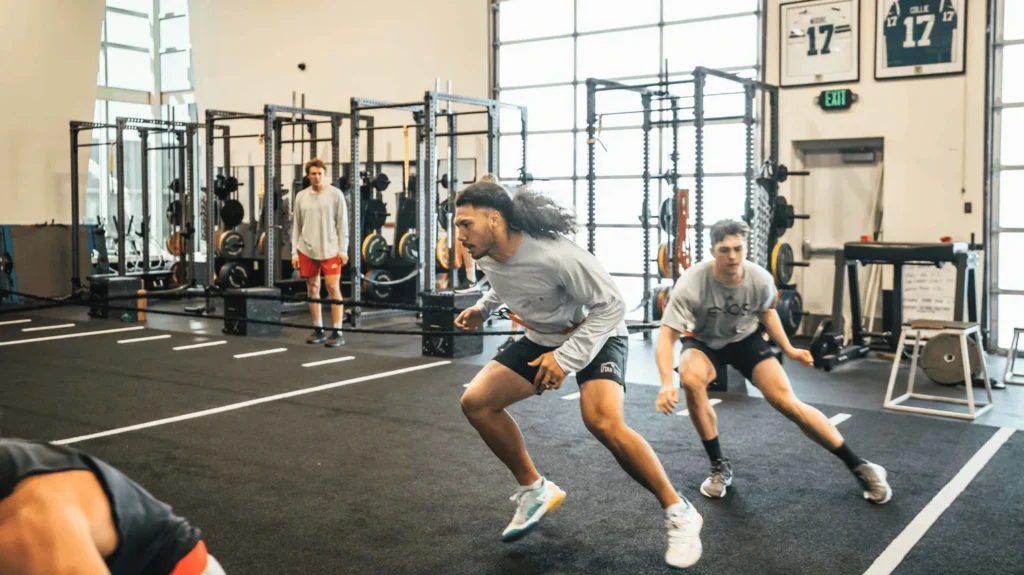
Not all exercises train the same movement. Athletes need to train for their specific sport, and that includes specific plyometrics.
Our personal training team talks about this all the time. Train for what you really need. Jump training is heavy in sports like basketball, where you see many of the most advanced exercises we covered here, like single leg bounds and tuck jumps. Players also add drills like side to side hops and skater jumps.
For soccer, the focus is different: Skipping, squat jumps, and rotational jumps show up more often.
Different sport, different drills.
But many jump exercise routines are not for athletes at all. Weekend warriors and fitness enthusiasts use them for conditioning. We include several of these movements in our top HIIT workouts.
And what about people who simply want better health? That can mean lowering fat and cholesterol, strengthening bones, or feeling more energized. If you ask your clinician or physio, they will likely recommend the same three beginner jumping exercises we went through: Squat jumps, box step ups with a jump, and jumping rope.
At P1, we have been working with the Salt Lake City community for over two decades. We train youth, adults and teams. We also help people rehab, recover, and get stronger.
We know that jump training is about pushing your limits, but it is also about pacing.
Ready to Jump Higher?
Wouldn’t you love to feel that powerful release from a good jump? Energy up. Heart pumping. Body feeling strong and alive.
Jump training is one of the most beneficial activities for athletes and non athletes alike. So why not train with a community that stays active, safe, and supported? At P1, you get the best equipment and the best pros guiding you every step of the way.Get started with your sessions today, and let’s jump.
